5540 River Road, Donalsonville, GA 39845

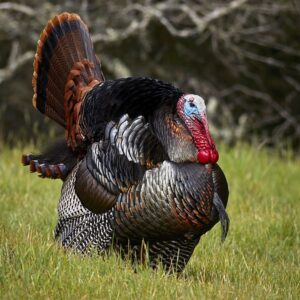
When you think of Thanksgiving, chances are a turkey comes to mind and rightly so! The turkey is a native game bird in North America and has a deep history throughout the continent. At McFadden Nature Center, with our focus on native animals and plants, we love our turkeys onsite and want to share with you a brief look at the fascinating story behind the wild turkey, the bird that inspired the domestic turkey we find on holiday tables.
The earliest known depiction of a turkey in North America is found in Native American rock art, likely created by indigenous peoples long before European contact. Some of these ancient petroglyphs and pictographs, which feature turkeys, are estimated to date back thousands of years. These early artworks illustrate the importance of turkeys to indigenous cultures, who used them not only for food but also for feathers, tools, and ceremonial purposes.
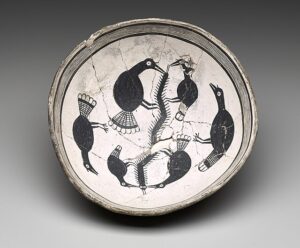
One notable example of early turkey depiction can be seen in Mimbres pottery from the American Southwest, dated between 1000 and 1150 AD. The Mimbres people, who lived in what is now New Mexico, Arizona, and northern Mexico, created intricate pottery designs that included stylized images of turkeys. These depictions highlight the bird’s significance in daily life and spiritual practices.
After European contact, the turkey made appearances in European art. John White, an English artist and cartographer who visited North America in the 1580s, created watercolors of New World fauna, including turkeys. These illustrations, along with White’s other images of indigenous life and landscapes, provide some of the earliest European depictions of turkeys from North America.
Native Americans had already domesticated turkeys in by the time of European contact, a process that began as early as 25 AD with a subspecies of the North American wild turkey. Spanish explorers encountered these domesticated birds and brought them back to Europe in 1519, where they spread rapidly and became popular among the elite.
The oldest known written European recipe for a turkey comes from the early 16th century, not long after Spanish conquistadors brought the turkey from the Americas. In 1525, a Spanish cookbook Libro de Cozina included a basic recipe for a turkey, sometimes called an “Indian fowl” or “Indian chicken”, to be roasted with spices. Most cookbooks after this were based off this theme of stuffing the bird with a variety of herbs and spices and serving with wine, a reflection of the growing popularity for the turkey as a delicacy in Europe for the wealthy. The turkeys in these early recipes were likely wild or minimally domesticated, quite different in taste and texture from the farm-raised birds familiar today. The original methods emphasized roasting or boiling, often with an elaborate stuffing and seasoned with ingredients like nutmeg, cloves, and ginger, spices that were popular in Renaissance-era cooking.
These early recipes paved the way for the turkey’s journey into broader culinary traditions and eventually its place in the iconic American Thanksgiving meal.
How the bird received its European name is not fully clear, but the main theory is that name “turkey” comes from a case of mistaken identity. Early European explorers thought these birds resembled guineafowl, which were imported through Turkey and called “turkey cocks.” However the turkey received its name, it has stuck!
Wild turkeys are impressive creatures and different from the highly domesticated turkey you get in the shops today. They can weigh up to 20 pounds and have a wingspan of nearly five feet. These birds are also fast and agile, able to run at speeds of 18-25 miles per hour and fly short distances. Unlike their domesticated counterparts, wild turkeys are highly intelligent and resourceful, foraging for grains, fruits, nuts, insects, and even small reptiles.
The species also has an inspiring comeback story. Overhunting and habitat loss brought wild turkeys close to extinction in the early 1900s, with only about 200,000 birds remaining in North America. Thanks to conservation efforts funded by the Pittman-Robertson Act and programs like trap-and-transfer, there are now approximately 6.5 million wild turkeys across the U.S. At McFadden Nature Center, we have the pleasure of being home to numerous turkeys and with over 1,200 acres, there is plenty of room for them to forage onsite. When you are out walking the trails, be sure to keep an eye out for them near our pecan and acorn trees, one of their favorite autumn food sources.
As Thanksgiving approaches, let’s take a moment to appreciate the turkey not just for its place on our tables, but for its resilience and beauty in the American wild!
We will leave you with a fun fact to bring up at the Thanksgiving table. In 1784, Benjamin Franklin wrote a letter to his daughter, Sarah, where he stated his wish that the bald eagle was not the representative of the United States because the bird was of “bad moral character” because it steals food from the fish hawk and is “too lazy to fish for himself.” Instead, Franklin called the turkey a “much more respectable bird,” a “true original native of America,” and a “bird of courage” that would “not hesitate to attack a grenadier of the British Guards.” While he never made his view on this matter public, the letter survives to this day.
– Have a Happy Thanksgiving from all of us here at McFadden Nature Center!