 5540 River Road, Donalsonville, GA 39845

In the forests of the eastern United States, a hidden gem of the American landscape
thrives – the American pawpaw tree, scientifically known as Asimina triloba. Known by
many names (pawpaw, papaw, paw-paw), this unique tree has enchanted locals and
travelers for centuries, bearing the largest edible fruit native to North America, outside of
the squash family.
The Pawpaw tree is an unassuming member of the understory, often growing in well-
drained, fertile bottomlands and hilly upland habitats. It is an adaptable species, thriving
in USDA Zones 5-9, and can reach heights of 10 to 25 feet. In spring, Pawpaw trees
bloom with deep maroon, six-petaled flowers, which stand out against its glossy, green
leaves. These leaves are distinctive for their pointed ends, stretching up to 12 inches
long, and in fall, they turn vibrant shades of yellow. We are starting to see the yellowing
of Pawpaw leaves onsite here at McFadden Nature Center in our six Pawpaw trees.
The transition from green to yellow is brief but beautiful and a welcome sight at
McFadden Nature Center.
The Pawpaw tree is the only tropical tree to grow this far north and the fruit itself is
unlike anything else grown natively in Noth America. Large, with a yellowish-green to
brown skin when ripe, it has a soft, custard-like flesh with a flavor profile somewhere
between a banana, mango, and pineapple. This native tropical fruit is a delicacy,
however, there’s a catch: Pawpaw’s are fragile, staying fresh only a mere few days after
picking so you must act fast. Wild fruits ripen from late August to mid-September, often
falling to the ground, where they quickly reach peak ripeness.
While Pawpaw fruit is edible, its seeds and skin contain toxic compounds, specifically
annonacin, which affects nerve cells, making careful preparation essential. Most people
tend to eat them raw, scooping out the large seeds and discarding the skin or slightly
chilled. Beyond its culinary appeal, the Pawpaw has an ecological complexity, as it is
self-incompatible – meaning it cannot fertilize its own flowers. This, combined with its
habit of forming clonal patches, often results in patches of Pawpaw trees that produce
no fruit at all. To boost pollination, some enthusiasts use clever methods like hand-
pollination or attracting carrion-feeding beetles by hanging chicken necks around the
tree. At McFadden Nature Center, we are trying new ways to pollinate the notoriously
difficult Pawpaw tree so don’t be alarmed if you see chicken necks hanging from their
branches! Research continues into which pollinators are most effective for Pawpaw’s,
though some suspect beetles and flies may be key.
The Pawpaw has a deep-rooted history with Native American tribes, who utilized the
fibrous bark to make ropes, fishing nets, and other essential items. The earliest written
documentation of a Pawpaw in North America dates to 1541, recorded by members of
the Spanish Hernando de Soto expedition, which observed the fruit cultivated by Native
Americans. Later, the Pawpaw made an appearance in the journals of Lewis and Clark,
who enjoyed it during their famous expedition, and legend has it that George
Washington himself was fond of chilled Pawpaw fruit as a dessert.
Despite its impressive historical roots, the Pawpaw remains somewhat obscure. It is a
resilient plant, resistant to most pests and requiring little pesticide intervention in its
native environment. Young trees grow best in shaded areas, though they become more
tolerant of sunlight as they mature. The tree’s adaptability to low-maintenance
conditions makes it ideal for the natural ecosystems it calls home.
As scientists and growers work to reintroduce the Pawpaw to a new generation, the
Pawpaw tree stands as a symbol of native resilience and biodiversity. The American
Pawpaw has truly earned its place as one of North America’s botanical
treasures—sweet, storied, and steeped in history.
Here at McFadden, we are cultivating a nurturing environment for native plants and
wildlife and the Pawpaw is just one of the hundreds of species we have onsite. One of
our goals with the Pawpaw tree is to cultivate enough genetic diversity within the trees
to produce fruits and bring the native Pawpaw and its delicious fruit back to our region.
Our vision is to see McFadden Nature Center as ‘a place to grow’ in Donalsonville,
Georgia!
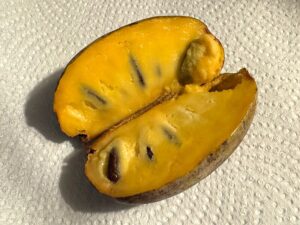
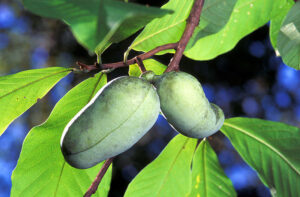
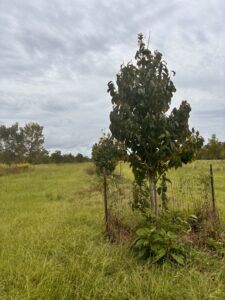
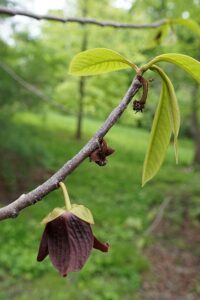
Image list:
Image 1: The Pawpaw tree with fruit on the branch. Used with permission from
WikiCommons
Image 2: The inside of the Pawpaw tree fruit. Used with permission from WikiCommons
Image 3: The maroon flower of the Pawpaw tree/ Used with permission from
WikiCommons
Image 4: One of the six Pawpaw trees onsite. Photo taken by Valerie Peacock
